Guest Blogger Mike Green: “Let’s Be Careful Out There”
“[I]n this atmosphere of economics now a change in a fundamental part of law affecting landholders is bound to have an effect on the cost of homeowner insurance if the word is out that there is a duty to trespassers. . . .
So before we move into this I ask that this be given very careful consideration because I believe in the courts this will bring about more confusion and its impacts on insurance could be very, very hard for people who are ordinary homeowners who right now are struggling to pay their insurance at this time.”
Victor Schwartz
American Law Institute Annual Meeting
The question of the impact of tort law changes on liability, costs, and insurance premiums lurks in many areas, although to date the primary area of inquiry has been in the medical malpractice field.* Victor’s statement addressed a draft Chapter of the Third Restatement of Torts that proposed rules imposing a duty of reasonable care on land possessors to all entrants on the land, save for a small class of trespassers, denominated flagrant trespassers. Flagrant trespassers are those whose entrance on the land is in egregious disregard of the owner’s rights and would include those who enter with the intent to do mayhem or commit other serious crimes while on the property. Victor, the pre-eminent lobbyist for entities that are subject to tort liability or insure against it, was arguing that liberalizing the duties imposed on land possessors could cause real hardship by increasing homeowners’ insurance premiums.**
Such arguments are common, but rarely is empirical data available or, if it is, analyzed. We were able to do some empirical inquiry on this question, unfortunately not until after Victor’s comment. Despite his dire predictions and the absence of any evidence refuting it, I am pleased to report that the
We realized, while researching and writing the Chapter on land possessor duties, that a huge natural experiment had taken place in this country from 1968 through 2009. During that period, roughly half the states had changed their law from the status-based duty rules inherited from feudal
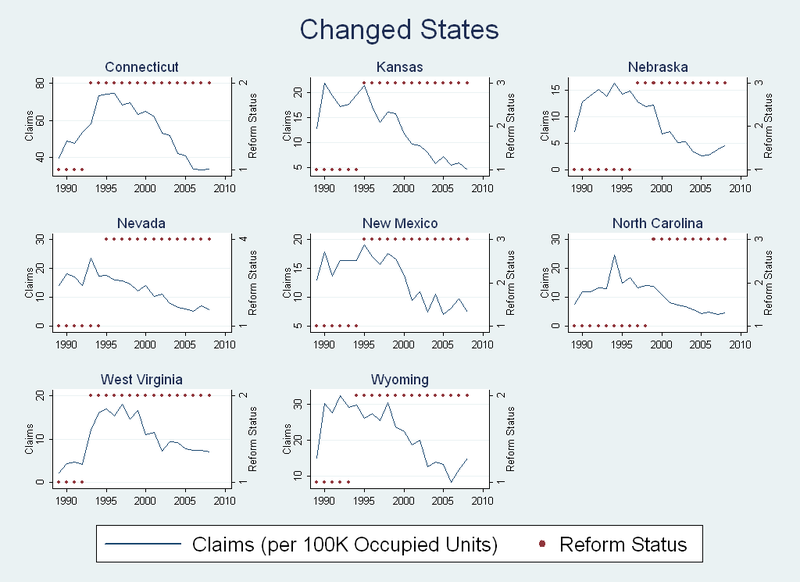
These tort law changes would permit an examination of their impact of these changes on the number of lawsuits and the magnitude of liability. We (my co-authors include Michael Heise of Cornell Law School and Brett Green of the Kellogg Graduate School of Business at Northwestern) were able to obtain data on a state-by-state basis from the Insurance Services Office, which gathers data from insurers and reports to state insurance commissions. ISO compiles composite data, and we secured that data for homeowners and renters’ liability claims and losses for a 20-year period from1989 through 2008.
Our initial examination consisted of the eight states that had reformed their land possessor law during the 20 years for which we were able to obtain data. Looking at the claims and loss experience before and after the change provides some evidence about whether the tort reform intervention had an impact.*** Below are graphs showing the losses (in dollars adjusted for inflation) per occupied unit (including homes, condominiums, and apartments) and the number of claims per 100,000 occupied units that occurred in each state over the 20 year period. Losses and claims are scaled on the left hand Y axis and shown in a blue line, while the legal rule of the state is scaled on the right side of the Y axis and shown in a dotted and discontinuous red line. A value of one on the “reform status” scale corresponds to the historical status-based duty rules, with only invitees owed a duty of reasonable care. Two reflects the most modest reform, providing both invitees and social guest with a duty of reasonable care; three includes all licensees in that duty; and four signifies a duty of reasonable care to all entrants, including trespassers.