
“It depends on what the meaning of the word ‘illegal’ is”
Just to tie up a loose thread from yesterday’s news about David Egilman settling with Lilly…
In Pharmalot’s first story breaking the news, this comment was reported:
However, Egilman’s attorney, Alex Reinert says that Egilman didn’tadmit to anything illegal. A quick read indicates he appears to becorrect (although we recognize that other interpretations are possible).
(Update: I hadn’t realized until just now that Reinert is evidently a lawprof, though he’s also still listed on a firm website. He’s also a graduate of Brown, where Egilman is a professor.)
And in the WSJ Health Blog post, there’s a similar comment, plus a discussion of what else Egilman admitted to in his affidavit:
Alexander Reinert, a lawyer representing David Egilman, the expertwho settled with Lilly, tells the Health Blog that the companymischaracterized his client’s signed statement. Egilman never admitteddoing anything illegal and didn’t cherry-pick documents to send theTimes. “Lilly has an interpretation we don’t believe is accurate,”Reinert says. While Egilman admitted to violating a protective order,“that’s not saying he did something illegal,” Reinert says.
First, on the question of whether he admitted to doing something illegal, I suppose it depends on what counts as illegal. I generally think of federal court orders as having the force of law, being, you know, oh, what’s that phrase? Oh, right — the basis for the rule of law. Here, Egilman unambiguously admitted [PDF] under oath to violating the protective order duly issued by a federal judge (“I violated Case Management Order No. 3 (‘CMO-3’), which is in force in the Zyprexa MDL.”).
The CMO (2004 WL 3520247; also available in a big PDF here: Download CMO3.pdf) provides in the endorsement certain acknowledgments about the force of signing. You can see Egilman’s signed endorsement here: Download cmo_endorsement_egilman.pdf. In that document, Egilman agreed:
I further agree and attest to my understanding that, if I fail to abide by the terms of the Order, I may be subject to sanctions, including contempt of court, for such failure. I agree to be subject to the jurisdiction of the United States District Court, Eastern District of New York, for the purposes of any proceedings relating to enforcement of the Order.
So he’s acknowledged (again under oath) that violation of the Order can result in sanctions, including contempt. This is, of course, not surprising, but bolsters the idea that violation of the order is illegal.
Black’s defines “illegal” in a pretty straightforward way: “illegal, adj. Forbidden by law; unlawful.” By that or any ordinary meaning of the term “illegal,” it seems to me that admitting violation of a court order (remember: court orders = force of law) constitutes admitting an illegal action. (Added: This is consistent with Judge Weinstein’s repeated use of the terms “illegal,” “stolen,” and “conspiracy” in his order, incidentally.)
And even if one were to limit the term to only include acts that are clearly criminal, recall that Egilman was at least concerned enough about potential criminal liability to invoke the Fifth Amendment right against self-incrimination, something he expressly acknowledges again in the affidavit. (See also this post.) That said, if “illegal” is in fact defined in such a constrained way as to only include clearly criminal conduct, it would be at least semi-credible to say that he didn’t admit to acting illegally.
As for the second argument — that he didn’t admit to cherry-picking documents — that seems plainly contradicted by the affidavit itself, which is worth excerpting at some length:
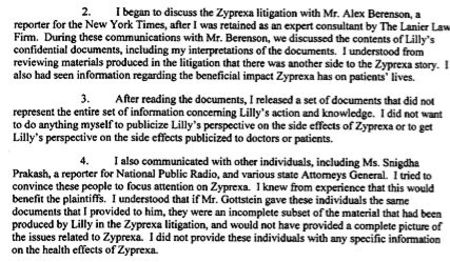
That seems to be at odds with his attorney’s statement: “Reinert says that’s not the same as cherry-picking: ‘He knew there were other documents but he didn’t have them.'” Note that Egilman says in his affidavit that he reviewed documents and released a set of documents — i.e., not all of what he had reviewed. Even if he no longer had them at hand, he undoubtedly could have obtained them; to call what he did anything other than cherrypicking would seem to give cherrypickers an unusual definition, to say the least.
–BC (who, as noted repeatedly before, does some consulting work for companies who are or have been adverse to parties for whom Egilman has served as an expert witness, but not including Lilly)